Main Content
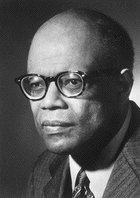
W. Arthur Lewis was the James Madison Professor of Political Economy at Princeton University and was awarded the Nobel Memorial Prize in Economic Sciences in 1979. Prof. Lewis was known for his two sector model of economic development, published in 1954. In this model labor migrated from a less organized and less productive sector (agriculture, petty trade, busking) to a more organized sector that created and employed capital to increase the productivity of labor, thereby increasing the returns to an “industrial class” who owned the capital. This led to myriad variations on two sector models of development that defined much of the economic growth literature in the last half of the twentieth century.
In my interpretation, a comparison of Lewis’s 1954 model and his 1979 Nobel Lecture, in which he admitted some surprise at less developed countries’ abilities to create capital, revealed a critical finding relevant to today’s K-shaped economic growth. Namely, we have ample evidence that capitalism can create wealth, and that poor people can create capital when the opportunity arises. The implication to me is that we should retain capitalism as a—in my opinion the best—way to increase national wealth, but that we have to create opportunities for all people to benefit by becoming owners of capital. This include first and foremost their own human capital, i.e. their knowledge and skill sets, as well as access to home ownership, stock markets, real estate investments, and other financial markets at a scale suitable to their income.