Main Content
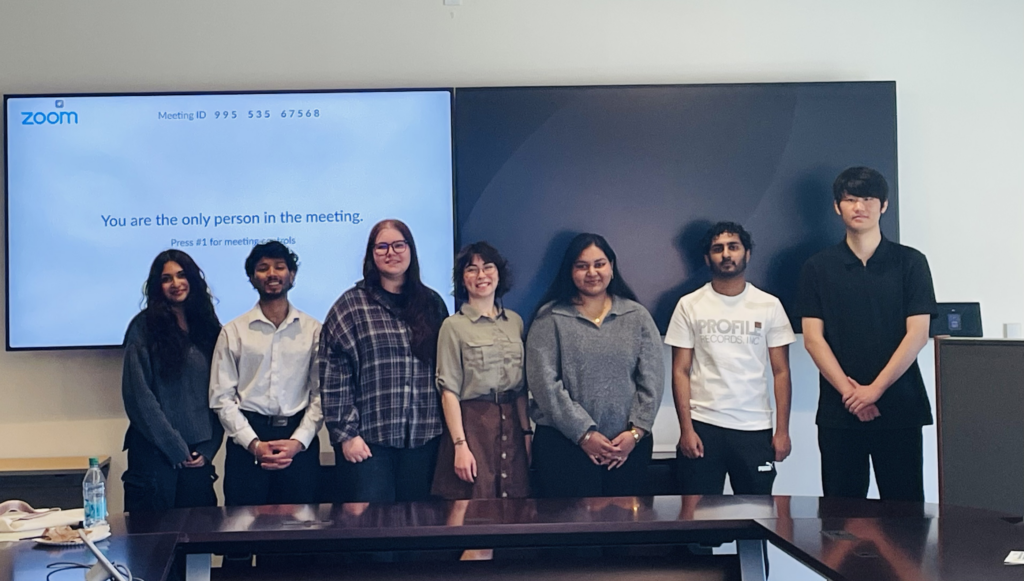
Audri Riana, Naren Karthikeyan, Eve Nevelos, Marian Hollenbeck, Sadhana Vasanthakumar, Nikhil Srinivas, and Ziyong Qu (left to right)
The Department of Agricultural, Food, and Resource Economics at Rutgers University recently hosted its inaugural Undergraduate Research Showcase, featuring student projects addressing key challenges in agriculture, sustainability, and global economic development.
Student teams presented research spanning topics from artificial intelligence and workforce skills to environmental policy and international development. One project analyzed more than 25,000 job postings to examine how generative AI is reshaping skill demands in agriculture, highlighting rising requirements in data analytics and GIS. Another study evaluated cost-effective solutions for PFAS water contamination in New Jersey, identifying ion exchange technology as the most efficient option. Additional projects examined the effects of informal-sector competition on manufacturing in Bangladesh and the relationship between exporting and productivity among Indian firms, offering policy-relevant insights for emerging economies. The showcase also featured Agoraponic Farms, a student-led initiative using hydroponic systems to address food insecurity on campus, which has donated more than 135 pounds of fresh produce to the Rutgers Food Pantry.
The event highlights DAFRE’s commitment to experiential learning and its role in preparing students to tackle complex challenges in food systems, environmental sustainability, and economic development.

Dr. Yanhong Jin, Sadhana Vasanthakumar, Nikhil Srinivas, & Ziyong Qu (left to right)
TITLE: Quantifying Generative AI’s Impact on Workforce Skill Demands: Evidence from Agriculture
and Sustainability Job Postings
STUDENT NAMES: Sadhana Vasanthakumar, Vinayak Ghai, Ziyong Qu & Nikhil Srinivas
FACULTY ADVISOR: Dr. Yanhong Jin, Department of Agricultural, Food, and Resource Economics
ABSTRACT: The job market is changing faster than the curriculum. The public release of ChatGPT in November 2022 provides a natural temporal break to examine whether generative AI has shifted what employers demand from early-career workers in agriculture and sustainability. We analyzed 25,516 entry-level job postings across federal USAJobs, private-sector postings via web scraping, and O*NET occupational data using Python-based NLP, sector reclassification, and OLS regression with company-clustered standard errors and state- and year-fixed effects.
Our findings reveal three key patterns. First, skill demands are rising: 86 new technologies were added to occupation requirements between 2020 and 2024, and Learning and Adaptability is the only skill category with a net positive trajectory. Second, the apparent salary gap between sectors disappears once General Schedule grade and location are controlled, confirming that sector choice matters less than placement for compensation outcomes. Third, entry barriers are growing: GIS and data analytics credentials now appear across 13 of 21 occupation categories that did not require them in 2020; federal early-career postings represent just 3.4% compared to 32% in the private sector; and over half of postings include ATS screening evidence.
These findings have direct implications for land-grant universities. Students without GIS or data analytics training face automated screening barriers for roles that did not require these credentials when current seniors enrolled. The integration of these tools into the curriculum, paired with career services focused on ATS optimization, represents the most actionable institutional response to the shifting demands documented in this study.

Eve Nevelos and Dr. James Oehmke (left to right)
TITLE: Benefit-Cost Analysis of Per- and Polyfluoroalkyl Substances (PFAS) Filtration and
Disposal in New Jersey Water Systems
STUDENT NAMES: Eve Nevelos, Heer Bhathawala, Yash Maheshwari
FACULTY ADVISOR: Dr. James Oehmke, Department of Agricultural, Food, and Resource Economics
ABSTRACT: Per- and polyfluoroalkyl substances (PFAS) are a class of man-made substances resistant to heat, oil, and water that negatively affect human health, particularly heart, thyroid, natal, and immune health. Addressing PFAS at the source, by filtering drinking water, is critical because there is currently no method to remove PFAS from the body, where they bioaccumulate in blood, organ tissues, and brain matter. The EPA estimates that its water regulations could save a minimum of $1.5B of health-related costs annually and prevent some 9600 deaths and 29900 illnesses each year. New Jersey boasts a rich industrial history, with some of the highest concentrations of PFAS in groundwater (>14 ppt PFOA, >13 ppt PFOS/PFNA) and soil (>30 ng/g) in the United States. Of 3300+ PFAS contamination sites in the US, New Jersey is home to 500 of them. New Jersey water treatment systems, in particular, must add PFAS remediation to their facilities. This study aids in determining which filtration methodologies to use for water treatment systems of varying sizes by providing recommendations based on a benefit-cost analysis conducted using Monte Carlo simulations. The analysis results found that ion exchange (IX) is the most economically effective method for removing PFAS from small- (~0.25 million gallons per day), mid- (~15 million gallons per day), and large-sized (~39.1 million gallons per day) water systems. Research on new filtration technologies must continue as they emerge, and PFAS contamination levels must continue to be monitored across industrial areas.
Naren Karthikeyan, Dr. Sanjib Bhuyan, & Audri Riana (left to right)
TITLE: The Effect of Exporting on Indian Manufacturing Firms’ Productivity
STUDENT NAMES: Naren Karthikeyan (presenter), Raya Rahman, and Vineeth Maryada
FACULTY ADVISOR: Dr. Sanjib Bhuyan, Department of Agricultural, Food, and Resource Economics
ABSTRACT: India’s rapid economic transformation has reshaped market competitiveness in its manufacturing sector. Utilizing cross-sectional data from the 2022 World Bank Enterprise Survey (WBES), this paper investigates the microeconomic factors driving firm productivity and market success. The Aresty project analyzes three primary dimensions: the relationship between export market access and manufacturing productivity (this presentation), the effects of transportation bottlenecks on manufacturing competitiveness, and the impact of employee training and foreign ownership on retail firm performance. We use multivariate statistical methods, including OLS, to analyze the WBES data to fulfill our study objectives. The findings indicate that while exporting manufacturing firms exhibit higher labor productivity, the duration of their export experience does not provide additional productivity gains, largely supporting the self-selection hypothesis over learning-by-exporting. Regarding logistics, the analysis uncovers a Perception Bias among Market Leaders, in which highly profitable, dominant firms report greater frustration with infrastructure despite experiencing lower proportional losses than micro-enterprises. However, objective physical transit losses do act as a direct tax on firm profitability, even though they do not significantly diminish overall market share. Finally, within the retail sector, structural factors such as firm size and age proved stronger determinants of productivity than employee training. Additionally, foreign ownership exhibited a significant negative effect on retail firm productivity in this specific sample used in this study. Overall, this research suggests that intrinsic firm characteristics and scale are the most consistent predictors of industry competitiveness in India’s evolving markets.
TITLE: Impact of Informal Sector Competition on the Manufacturing Sector in Bangladesh
STUDENT NAMES: Audri Riana (presenter), John Freeman, and Yassir Khan
FACULTY ADVISOR: Dr. Sanjib Bhuyan, Department of Agricultural, Food, and Resource Economics
ABSTRACT: Bangladesh’s transition toward upper-middle-income status and graduation from the Least Developed Country (LDC) classification places greater emphasis on sustained industrial growth, particularly in the manufacturing sector. Despite its central role in export earnings and employment generation, manufacturing firms in Bangladesh face persistent structural barriers that may constrain innovation, productivity, and employment expansion. The Aresty project focused on investigating three key constraints: limited access to finance, unreliable electricity supply, and competition from the informal sector (the focus of this presentation). We use firm-level data from the 2022 World Bank Enterprise Survey (WBES) for Bangladesh and employ multivariate regression and other statistical analyses to address the research objective. The findings of this study suggest that informal competition has a significant negative impact on firm-level labor productivity and a weak negative impact on firm profitability. The overall project’s findings emphasize that policies aimed solely at expanding one or two key factors may be insufficient to drive firm growth. Rather, improving SME performance requires complementary interventions, including support for skill development, improving managerial capacity, and incentives for technological adoption, particularly for smaller firms that face structural constraints. In the case of informal competition, strengthening access to finance and reducing regulatory barriers for small firms, alongside policies that encourage informal-sector formalization, can address competitive distortions and improve firm performance. The results are expected to inform policy discussions on SME financing, infrastructure investment, and formalization strategies, all of which are critical to sustaining Bangladesh’s industrial growth trajectory.

Marian Hollenbeck and Dr. Sonal Pandey (left to right)
TITLE: Agoraponic Farms
STUDENT NAMES: Marian Hollenbeck, Luigi Aiello, Raadha Garg, and 10+ others
FACULTY ADVISOR: Dr. Eugene Gentile, Rutgers Business School
ABSTRACT: Agoraponic Farms is a student-led nonprofit dedicated to combating food insecurity and promoting sustainable agriculture through hydroponic farming. Our team operates 4 hydroponic systems at Rutgers in Heylar House, Harvest IFNH, the Student Basic Needs Center, and the Floricultural Greenhouse, and we donate our produce to the Rutgers Food Pantry. In the 2025-26 academic year, we have donated over 135 pounds of fresh produce, and have participated in numerous Rutgers-based and national level pitch competitions. Our next phase is to replicate our proven model at other universities and food pantries through the sale of our services. On-site hydroponics directly addresses difficulties faced by food pantries in sourcing produce year-round by creating a sustainable, local supply of nutritious produce while educating system caretakers about self-sufficient agriculture.